
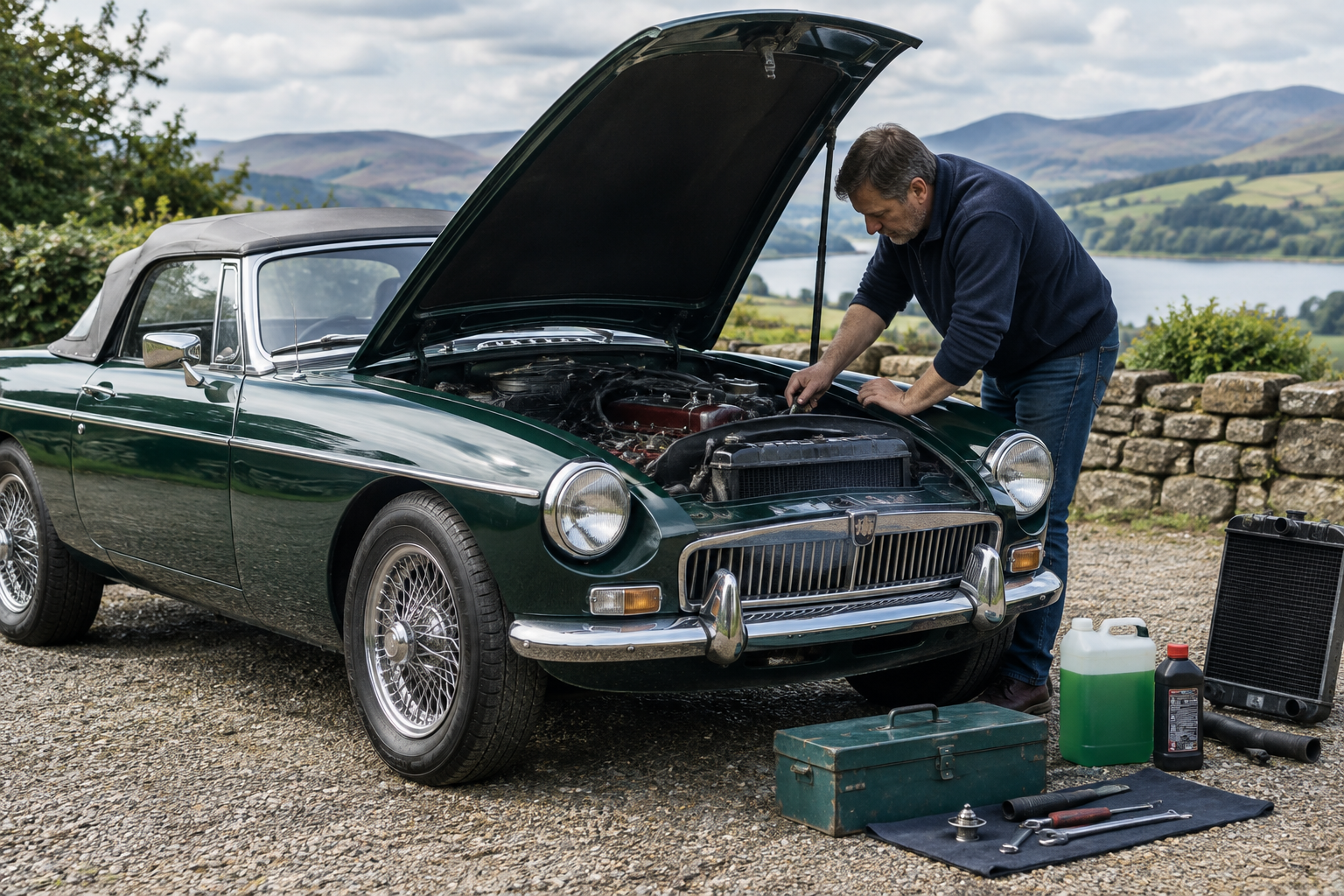
An MGB cooling system is simple in principle, but it has an important job. It must remove heat from the engine, keep temperatures within a useful operating range and help protect the cylinder head, gasket, radiator and other components from avoidable stress.
Many cooling problems are not caused by one dramatic failure. They develop through a combination of an ageing radiator, a tired hose, an inaccurate gauge, restricted airflow or coolant that has not been changed for too long. Regular inspection can identify these issues before they become an interruption to enjoyable driving.
This guide explains the main parts of the MGB cooling system, the checks an owner can carry out safely and the signs that more detailed investigation is needed.
How the MGB cooling system works
Coolant circulates through passages in the engine and cylinder head, absorbing heat as the engine runs. It then travels to the radiator, where heat is transferred to the surrounding air. The cooled liquid returns to the engine and the cycle continues.
The thermostat controls when coolant begins to flow through the radiator. When the engine is cold, the thermostat remains closed or largely closed, allowing the engine to warm up efficiently. As temperature rises, it opens and permits greater circulation through the radiator.
Other important parts include the water pump, radiator cap, hoses, fan, drive belt and temperature sender. On some cars, the original mechanical fan remains in service; others may have been fitted with an electric fan during previous maintenance or restoration work. The exact arrangement should be checked on the individual car rather than assumed.
Why cooling performance matters
An engine that runs too hot can suffer from poor drivability, coolant loss and damage if the problem is ignored. Overheating may contribute to issues such as a failed head gasket, a distorted cylinder head or damage caused by inadequate lubrication at high temperature.
Running too cool is not ideal either. If the engine takes a long time to reach its normal operating temperature, or never appears to warm properly, the thermostat may be stuck open or the temperature reading may be inaccurate. An engine that does not reach a suitable operating temperature can be less efficient and may encourage condensation and sludge in the oil system.
The temperature gauge is useful, but it should be treated as one part of the evidence. Gauge readings can be affected by the sender, wiring, instrument voltage supply or the gauge itself. A sudden change from the car’s usual reading is worth investigating, even if the needle has not entered the highest part of the scale.
Inspecting the radiator
Begin with a visual inspection when the engine is cold. Look for damage to the radiator core, bent fins, corrosion around the tanks and signs of dried coolant. Mud, leaves and other debris can restrict airflow through the fins. Light surface dirt may be cleaned carefully, but fragile fins can be damaged by excessive water pressure or rough brushing.
Check whether the radiator appears to be sitting securely and whether the surrounding shroud or mounting brackets are intact. A radiator that moves excessively can place strain on its connections and hoses. Previous repairs are not automatically a concern, but their quality and condition should be considered alongside the rest of the system.
Internal restriction is harder to identify from the outside. A radiator can look acceptable while suffering from blocked passages or reduced heat-transfer performance. If the engine overheats despite good airflow, correct coolant level and a functioning thermostat, professional testing or removal may be appropriate.
Coolant, water and corrosion protection
Coolant is not simply water with a colour added. A suitable antifreeze and corrosion-inhibiting product helps protect the cooling system and provides freeze protection. The correct product and mixture should be selected with reference to the engine, radiator materials and manufacturer or supplier guidance.
Do not mix different coolant products without checking compatibility. If the history of the existing coolant is unknown, a complete drain, flush and refill may be preferable to repeatedly adding small amounts of an unconfirmed product. A cooling system should be filled with clean, suitable fluid rather than relying on whatever happens to be available.
Check the coolant level only when the engine is cold. Opening a hot radiator or expansion vessel can release pressurised liquid and cause serious burns. The level should be interpreted according to the type of system fitted and the markings on the relevant tank or radiator. Avoid overfilling, as coolant expands as it warms.
Coolant should be replaced at sensible service intervals rather than left indefinitely. The interval depends on the product used and the vehicle’s maintenance requirements. Keep a record of what has been added and when, especially if an MGB has had replacement hoses, a radiator or other cooling-system work.
Hoses, clips and the water pump
Rubber hoses age from the inside as well as the outside. Look for cracking, swelling, soft sections, chafing and staining around the ends. A hose that feels unusually soft or has become hard and brittle should not be ignored. Pay attention to smaller bypass or heater hoses, which can be overlooked during routine checks.
Clips should hold hoses securely without cutting into the rubber. A coolant stain around a joint may indicate a loose connection, a damaged hose end or a distorted fitting. Tightening a clip may help in some cases, but it is not a substitute for replacing a hose that has deteriorated.
The water pump must circulate coolant effectively and maintain a reliable seal. Noises from the pump area, visible leakage or excessive play at the pulley may indicate a problem. A failed or weakened pump can lead to overheating, but a temperature rise should not automatically be attributed to the pump without checking the rest of the system.
Thermostat operation
A thermostat that remains closed can restrict circulation and cause rapid overheating. One that remains open can make warm-up slow and may result in a consistently low temperature reading. Symptoms can overlap with other faults, so diagnosis should include the gauge, sender, coolant level and radiator condition.
The thermostat should be installed in the correct orientation and with an appropriate seal. If it has been removed by a previous owner in an attempt to cure overheating, that may have created further problems rather than solving the original cause. The cooling system needs controlled circulation, not simply unrestricted flow.
Fans and airflow
The fan must be capable of moving air through the radiator, particularly when the car is stationary or moving slowly. Inspect the blades for cracks, looseness or signs of contact. Check that the fan is fitted securely and that the belt, where applicable, is correctly tensioned and not damaged.
If an electric fan is fitted, check its wiring, fuse, switch or temperature sensor and mounting. It should not obstruct the radiator unnecessarily, and its direction of airflow must be correct. Some installations are modified during a car’s life, so neat routing, secure connections and suitable protection are important.
Overheating only in slow traffic may point towards inadequate airflow, while overheating during sustained faster driving can suggest restricted coolant flow, a radiator problem, an incorrect mixture or another engine-related fault. These are useful clues, but not conclusive diagnoses.
Recognising possible overheating
Warning signs include a rising temperature gauge, steam, coolant smell, loss of coolant, bubbling in the radiator or expansion system and a sudden change in engine behaviour. If the gauge moves higher than usual, reduce the load on the engine and find a safe place to stop. Switch the engine off if the temperature continues to rise or if there are clear signs of coolant loss.
Never remove a radiator cap while the system is hot. Allow the car to cool fully before checking the level or looking for the cause. Once cool, inspect for split hoses, loose connections, a damaged belt, leakage around the radiator and evidence of coolant being expelled from the system.
Repeated coolant loss should always be investigated. External leaks can be small and difficult to see, while internal coolant loss may be associated with combustion gases, a head-gasket issue or another engine fault. White deposits around a joint can show where coolant has evaporated, but a clean engine bay does not prove that no leak is present.
Preventative maintenance for an MGB
A sensible cooling-system routine can be included in normal servicing:
- Check the coolant level and visible condition when the engine is cold.
- Inspect hoses, clips, the radiator and the water-pump area for leaks or deterioration.
- Check the fan, belt and surrounding airflow path.
- Watch for changes in the usual temperature-gauge reading.
- Replace coolant according to the product and vehicle requirements.
- Deal with small leaks before they become larger failures.
It is also worth confirming that the engine bay has not been assembled with mismatched parts or poorly supported wiring. A well-maintained cooling system should be straightforward to inspect, refill and service.
Cooling-system considerations during restoration
Restoration is an opportunity to assess the complete system rather than replacing only the most visibly worn component. The radiator, water pump, thermostat, hoses, fan arrangement, heater circuit and gauge sender should be considered together. Reconditioned original parts can be appropriate, while replacement components may be selected where condition, availability or intended use makes that sensible.
Any modification should have a clear purpose and should be installed carefully. A larger radiator or electric fan is not a cure for every overheating problem. Poor ignition settings, a weak mixture, incorrect engine assembly, blocked passages or a faulty gauge can all produce temperature-related symptoms. Diagnosis should come before unnecessary parts replacement.
For owners considering a rebuilt or comprehensively prepared car, the MGB rebuild specification provides a useful point of reference for the type of work and detail that may be considered during a rebuild. For advice about a particular car or cooling-system concern, you can contact California Classics.
A calm, methodical approach
The MGB cooling system rewards regular attention. Checking the level when cold, looking for early signs of leakage and noticing changes in the temperature gauge can prevent a minor fault from becoming a major repair. When a problem occurs, avoid guessing from one symptom alone. Confirm the coolant level, airflow, thermostat operation, circulation and temperature reading in a logical order.
Good cooling performance is part of dependable classic-car ownership. With appropriate maintenance and careful diagnosis, an MGB can remain enjoyable to drive without losing the character that makes these cars so appealing.