
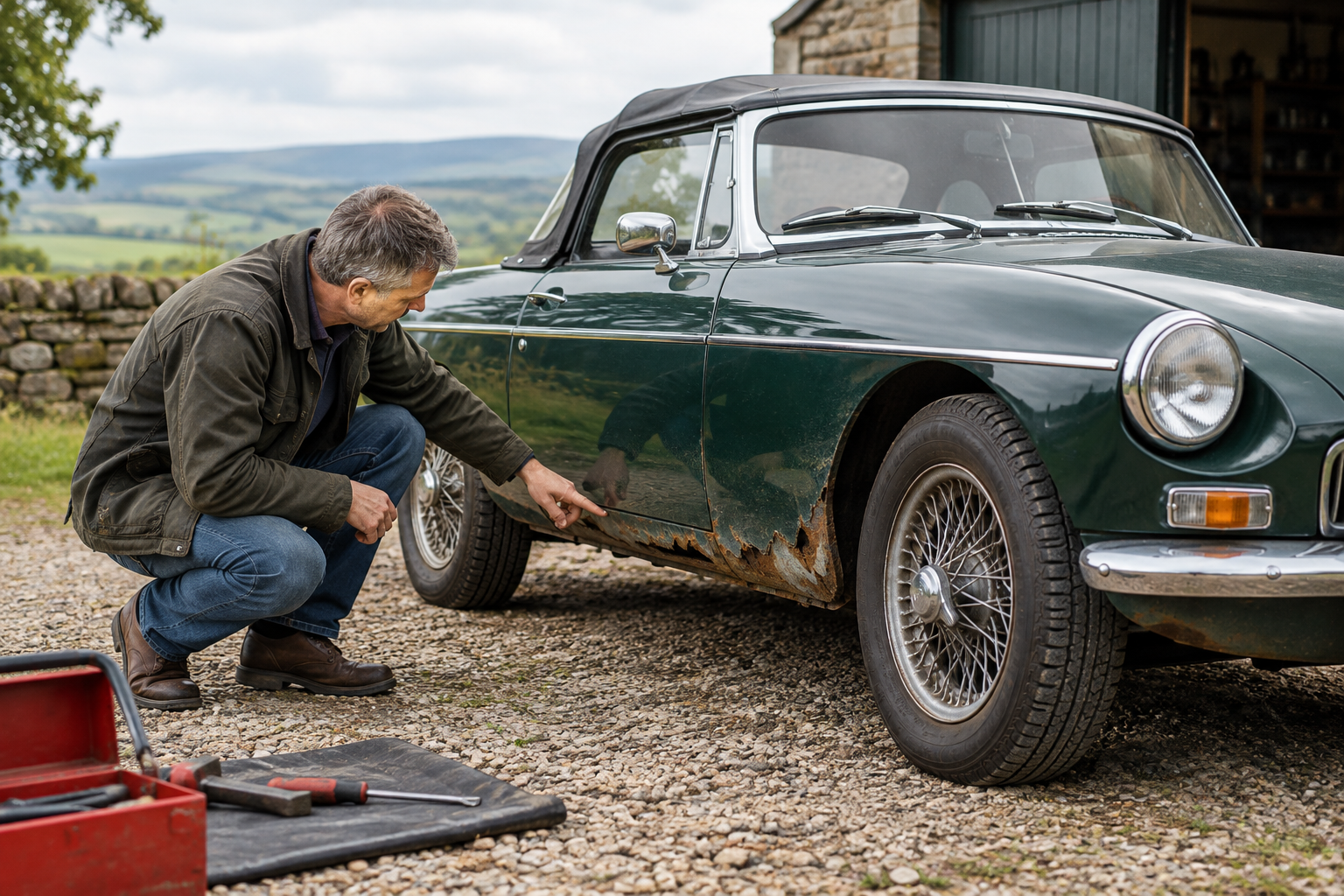
Rust is one of the most important considerations when assessing an MGB. Mechanical components can often be repaired, replaced or rebuilt in a relatively planned way, but corrosion can affect the shell, panels, mounting points and overall identity of the car. A bright paint finish may conceal previous repairs, while an untidy-looking area may prove more straightforward than expected once properly examined.
The aim of a bodywork inspection is not simply to find rust. It is to understand where it is, why it has formed, how far it extends and whether an earlier repair has dealt with the cause. This applies whether you are considering an MGB Roadster, an MGB GT or a car already in your ownership that needs attention.
Why MGB corrosion needs careful assessment
Corrosion is rarely limited to the first visible bubble in the paint. Water, road dirt and moisture can collect behind seams, around fittings and inside enclosed sections. Once the protective finish has been breached, corrosion may continue from the reverse side of a panel, where it is difficult to see during a quick inspection.
The location of rust matters as much as its appearance. Surface oxidation on a removable outer panel is a different proposition from corrosion affecting a sill, suspension mounting area or structural connection. The latter may influence the safety, alignment and long-term viability of the car, and should be assessed by someone with appropriate experience.
It is also useful to distinguish between original metal and previous repair work. A car may have received replacement panels, localised patches or extensive restoration during its life. None of these automatically makes it a poor example, but the quality, extent and documentation of the work can affect future maintenance and restoration decisions.
Common areas to inspect on an MGB
Every car should be examined individually, but several areas deserve particular attention. Look at the outside first, then consider what may be happening behind or below each visible surface.
Sills and lower body sections
The sills are exposed to water, dirt and damage from the road. Examine the full length of each sill, including the front and rear ends, the lower edges and the area beneath any trim. Pressing hard against suspect metal is not a substitute for proper inspection, but changes in surface texture, swelling seams or fresh underseal can indicate that further investigation is needed.
On a Roadster, the sill area also sits within the structure of the open-bodied car, so its condition should not be treated as a cosmetic matter. On a GT, the surrounding bodywork and floor areas still require careful examination, even though the roof design differs.
Wheel arches and wings
Wheel arches receive spray from the tyres and can trap mud. Inspect the outer lip, the inner arch and the areas where panels meet. Look for bubbling paint, uneven edges, cracking filler and differences in texture between one side and the other. A symmetrical appearance is not proof of soundness, but an obvious difference can provide a useful clue.
The lower sections of the front wings, rear wings and door skins are especially vulnerable to moisture and road debris. Pay attention to the bottoms of doors and the edges where dirt can remain after the car has been washed.
Floors and chassis-related areas
Lift carpets and removable trim where practical, and inspect the floor from above as well as below. Dampness, staining, previous patches or a coating that looks newer than the surrounding metal all warrant closer attention. Check drainage points and look for signs that water has entered the cabin or been retained beneath sound deadening.
On an MGB, important mounting areas and structural connections should be examined carefully rather than judged from appearance alone. If access is limited, a ramp and suitable lighting can make a considerable difference. Corrosion close to suspension, steering, brake or body mounting points should be treated as a priority for professional assessment.
Boot, battery and moisture traps
The boot floor and surrounding panels are worth inspecting for dampness, staining and corrosion. Battery locations can suffer from contamination if a battery has leaked or if moisture has remained in the area. Check beneath mats and around seams, but avoid assuming that a clean, freshly painted boot is necessarily original or corrosion-free.
Door, bonnet and boot shut lines
Panel gaps can provide useful evidence about previous work, although they should never be considered conclusive on their own. Compare the gaps from side to side and check whether doors, the bonnet and the boot open, close and latch consistently. Misalignment can result from adjustment, worn hinges, accident damage, corrosion or earlier panel replacement.
Recognising previous repairs
Restoration work varies considerably in method and quality. A repaired area may show a change in paint texture, a visible edge, rippling, excessive sealant or a slightly different reflection. A magnet can sometimes help identify filler on steel panels, but it is not a complete test and should be used carefully. Aluminium, trim, thick paint and access limitations can all make results misleading.
Inspect the underside of seams and the reverse of panels wherever access allows. Uneven welds are not automatically evidence of poor work, particularly on an older restoration, but incomplete welds, open gaps or extensive heat distortion deserve attention. Fresh underseal can also conceal both sound repairs and unresolved corrosion, so its presence should lead to questions rather than reassurance.
Ask whether photographs, invoices or other records exist. Documentation can help establish what was replaced, when work was undertaken and whether the current appearance matches the car’s history. If the information is incomplete, record what can be seen and plan for the possibility that hidden areas may require further investigation.
Surface rust, perforation and structural corrosion
Surface rust usually affects the finish without having penetrated the metal. It may still need prompt treatment, because corrosion tends to become more difficult to contain once the protective coating has broken down. The correct repair normally involves removing corrosion, preparing the metal properly and restoring suitable protection rather than simply covering the affected area.
Perforation means that corrosion has created holes or severely weakened the panel. The appropriate repair may involve cutting out the affected metal and welding in a properly shaped section, or replacing the panel where that is the more sensible solution. The visible hole may be smaller than the area of weakened metal surrounding it.
Structural corrosion concerns the parts of the body that contribute to strength, mounting security or alignment. It should not be treated as a cosmetic project. A repair plan needs to establish the extent of damage, support the shell correctly where necessary and restore the relevant sections to an appropriate standard.
Planning effective bodywork repairs
A durable repair begins with diagnosis. Before cutting metal or ordering panels, identify the source of moisture, the full extent of corrosion and the condition of nearby sections. Repairing only the visible rust while leaving contaminated seams, blocked drains or damaged inner panels in place may result in the problem returning.
Decide whether the work is localised or part of a larger restoration. Local repairs can be appropriate when the surrounding metal is sound and the finish can be blended acceptably. More extensive work may be justified where several adjoining panels are affected, previous patches overlap or the car is being dismantled for a full rebuild.
Panel choice also deserves thought. Original panels, good-quality reproduction panels and repair sections may each have a place, depending on availability, fit, condition and the intended use of the car. The goal should be sound, accurately fitted metal rather than replacing components simply for appearance.
Good preparation is as important as the welding itself. The repaired area should be cleaned, shaped and protected, with seams and cavities treated appropriately. Paint and underbody protection should be applied only after the underlying metalwork has been properly prepared. Exact products and methods will depend on the repair system and the area being treated, so follow the manufacturer’s instructions.
Preserving an MGB during restoration
Not every MGB needs a complete bare-shell restoration. A car may have honest, usable bodywork that requires careful local attention rather than wholesale replacement. Decide what level of work suits the car, its intended use and the available time and budget. A sound mechanical recommissioning combined with targeted body repairs may be more appropriate than dismantling an otherwise usable example.
It is also worth preserving evidence of the car’s development and past work. Photograph areas before dismantling, label removed parts and keep a record of repairs. This helps during reassembly and can prevent sound original details being lost unnecessarily. Where a specification or finish is being changed, make the decision deliberately rather than allowing replacement parts to dictate the result.
For examples being rebuilt to a particular specification, a written scope of work can be useful. It should identify the body sections involved, the expected finish, any known limitations and the work that is outside the agreed scope. If you are considering a professionally prepared car, you can view the MGB rebuild specification for an indication of how a rebuild may be described.
Looking after repaired bodywork
Once bodywork is repaired, prevention becomes part of ownership. Keep drainage paths clear, remove accumulated dirt from arches and lower edges, and investigate damp carpets or boot trim rather than allowing moisture to remain. Regular washing is useful, but water should not be directed into areas where it can become trapped.
Inspect the underside periodically, particularly after wet use or before laying the car up. Small changes such as a new blister, damaged coating or seam that remains damp are easier to address early. Avoid applying fresh protective material over dirt, loose rust or moisture, as this can make future inspection more difficult.
Good storage also helps. A dry, ventilated environment is preferable to a place where condensation regularly forms. A breathable cover can protect a clean car, but it should not be used to conceal dampness. The basic principle is simple: keep water out where possible, provide a route for it to escape and repair damage before it spreads.
Choosing an MGB with bodywork in mind
When comparing cars, consider the whole condition rather than focusing on paint colour or a single repaired area. An honest car with visible, manageable work may be easier to understand than one with a polished finish and limited information about what lies beneath it. Compare photographs, records, underside condition and the quality of previous repairs.
If you are looking for an MGB, the current stock page is the natural place to see cars presently offered by California Classics (Hull) Ltd. Previous examples can be viewed through the sold cars page, although each car should still be judged on its own condition and documentation.
For advice about a particular car or restoration requirement, use the contact page to make an enquiry. A clear description, photographs and details of the areas causing concern can make any initial discussion more useful.
Final thoughts
MGB bodywork should be assessed patiently and from more than one angle. Look beyond the paint, understand the difference between cosmetic and structural corrosion, and treat previous repairs as part of the car’s history rather than an automatic verdict. With a realistic plan and suitable inspection, rust does not have to end the conversation about an MGB—but it should always inform the decision about its condition, value and future work.