
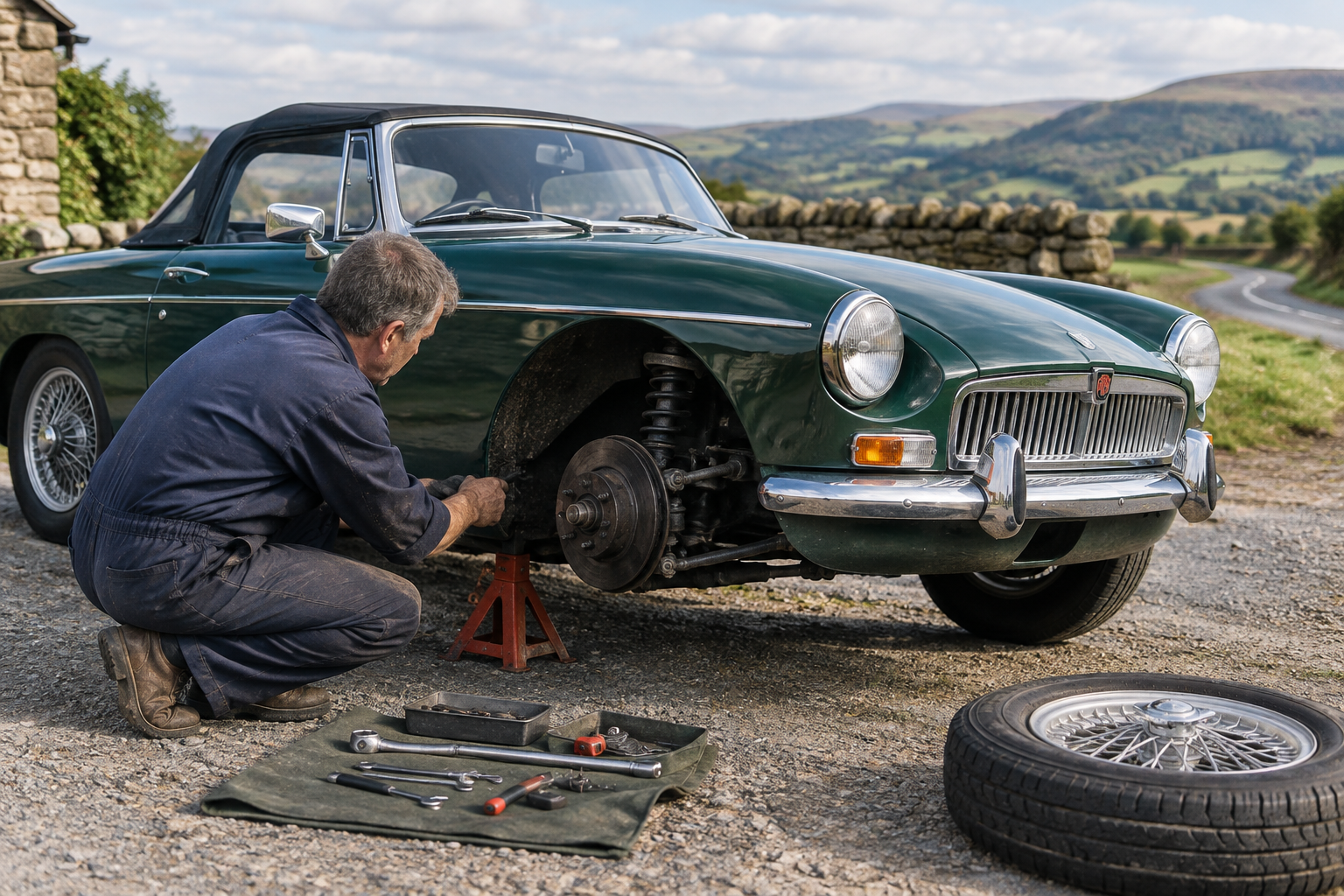
An MGB should feel light, communicative and enjoyable without being nervous or vague. When the suspension and steering are in good condition, the car responds neatly to driver input and gives useful feedback through the wheel and seat. When components are worn, incorrectly adjusted or poorly matched, even a sound engine and gearbox cannot make the car feel right.
Suspension work is therefore about more than improving handling. It is also part of preserving the character of the car. An MGB does not need to be made harsh or extreme to be rewarding. Careful inspection, correct assembly and sensible replacement of worn parts will usually make a greater difference than fitting the most aggressive components available.
Understanding the MGB layout
The exact arrangement varies between models and specification, but MGBs use a conventional front suspension with coil springs, wishbones and lever-arm dampers. At the rear, the live axle is located by leaf springs, with dampers controlling its movement. Steering is through a rack-and-pinion system on many MGB models, giving the car a direct feel when the joints, rack and alignment are in good order.
This relatively straightforward design is one of the advantages of an MGB. Individual parts can be inspected, serviced or replaced without relying on complex electronic systems. The disadvantage is that wear can accumulate gradually. A car may still be usable while several small faults combine to produce imprecise steering, uneven ride height or a tendency to wander.
Start with a methodical inspection
Before ordering parts, establish what the car is actually doing. Make a note of symptoms rather than assuming that one component is responsible. Does the car pull to one side under braking, or does it wander constantly? Is there a knock over bumps? Does the steering fail to return after a turn? Is one corner visibly lower than the others?
Inspect the car on level ground, with the wheels pointing straight ahead. Look for obvious differences in ride height, damaged components, leaking dampers, split rubber bushes and uneven tyre wear. A clean, dry underside is easier to assess than one covered in dirt or excess grease, but avoid cleaning away evidence before noting where fluid or lubricant may have been present.
Raise the car safely when checking underneath. Use suitable axle stands on firm ground and never rely solely on a jack. If you are not confident supporting the vehicle or identifying play in a joint, use a suitably equipped workshop.
Checking steering components
Steering play can come from more than one place. The steering wheel, column, rack, track rods, track-rod ends and front suspension joints all contribute to the final result. A small amount of movement at several points can become a noticeable delay at the road wheels.
With the front wheels safely off the ground, check for movement at the wheel and watch which components move first. Movement between the hub and suspension upright may indicate a bearing or joint issue, while movement at the track-rod end or rack connection points towards the steering linkage. The steering rack itself should be inspected for secure mounting and signs of damage or leakage where applicable.
Do not adjust steering components simply to remove a symptom. Excessive tightening can make the steering stiff or mask a worn part. Once worn components have been renewed, the front alignment should be checked using accurate equipment. Toe settings are particularly important to the way an MGB feels, and the correct setting depends on the model and specification.
Front suspension wear points
Rubber bushes work hard because they control movement while also allowing the suspension to articulate. With age, they can crack, harden or deform. A worn bush may produce a vague steering response, a knock or uneven tyre wear. Replacing bushes in a thoughtful, consistent manner is usually preferable to changing one isolated item without considering the rest of the axle.
Check the wishbone bushes, lever-arm damper mounting points and associated fasteners. Look for damaged threads, distorted mounting holes and signs that a component has been tightened while the suspension was hanging. Some suspension bushes need to be tightened at the normal ride height so that they are not permanently twisted when the car is lowered. Always follow the instructions for the specific part and model.
Front wheel bearings should rotate smoothly and be adjusted correctly. A bearing that is too loose may allow movement, while one that is too tight can generate heat and suffer premature wear. This is a job where careful adjustment and a final check are more important than simply removing all detectable movement.
Leaf springs and the rear axle
The rear leaf springs are both suspension springs and part of the axle-location system. Their condition has a direct effect on ride height, axle movement and the way the car settles after a bump. Inspect the spring leaves, front and rear mounting points, shackles and bushes. Corrosion, cracking, distortion or excessive movement should be investigated before the car is used regularly.
Unequal rear ride height may be caused by tired springs, damaged mounting parts or a problem elsewhere in the structure. It is worth measuring rather than relying only on visual judgement. Check on a level surface with the car in a consistent condition, and compare measurements from repeatable points.
Rear axle movement can also produce clunks that are mistaken for differential or gearbox faults. Examine the spring eye bushes and shackle arrangements, as well as the damper fixings. The axle should be secure, but its suspension must still be able to move freely through its intended travel.
Dampers, springs and ride quality
Dampers control how quickly the suspension moves; they do not support the car's weight in the same way as springs. A leaking or weak damper may allow repeated bouncing, poor control over undulating roads or an unsettled feel after a bump. Check for oil leakage, damaged arms or loose mountings, and compare the behaviour of each side.
Replacement dampers and springs should be chosen as a matched approach. Standard-type components may suit an MGB intended for relaxed road use, while a carefully selected uprated setup may suit a car used more actively. Stiffer is not automatically better. Excessive stiffness can reduce grip on uneven surfaces, make the car tiring to drive and place additional stress on mounting points.
Ride height changes also affect suspension geometry. Lowering an MGB may alter the relationship between its suspension components and reduce available bump travel. Any change should be considered as part of the whole system rather than as a cosmetic alteration.
Polyurethane bushes and other upgrades
Modern replacement bushes can offer useful durability and a different steering response, but the material and hardness should suit the application. A full set of very firm bushes may make the car feel more immediate while also transmitting more noise and vibration into the cabin. On a road car, a mixture of standard-style and upgraded components can sometimes offer a more balanced result than fitting the firmest option everywhere.
When comparing parts, consider the intended use, the condition of the surrounding components and whether replacement will be straightforward in the future. The quality of fit is as important as the advertised material. A bush that does not seat correctly, or a mounting face that is corroded or distorted, can undermine the result.
Tyres, wheels and alignment
Suspension diagnosis should include the tyres and wheels. Incorrect pressures, mismatched tyres, damaged sidewalls or a buckled wheel can create symptoms that resemble suspension faults. Check for even wear and confirm that the tyres are suitable for the car and used in a consistent condition.
Wheel alignment should be checked after significant suspension work and whenever the car has developed a persistent pull or uneven wear pattern. Alignment is not a cure for worn joints, bent components or incorrect ride height, so those matters should be resolved first.
Keep a record of the work carried out, including the parts fitted and any alignment measurements. This is useful for future maintenance and helps distinguish a new fault from a characteristic that was already present.
Restoration and specification choices
During a restoration, suspension components are often accessible while other work is being completed. That can be an efficient time to inspect mounting points, replace tired fasteners and deal with corrosion. However, avoid replacing sound original components merely because newer alternatives are available. A good restoration is based on condition, purpose and compatibility.
If you are considering a rebuilt or restored MGB, ask how the suspension specification relates to the car's intended use. Information about a particular build may be available through the MGB rebuild specification page. For examples of cars that have already found homes, the sold cars section can also provide useful context when considering different approaches to specification.
A sensible order of work
- Record the symptoms. Note when the problem occurs and whether it changes with speed, braking or road surface.
- Check the basics. Inspect tyre pressures, wheel condition, visible damage and ride height.
- Find movement. Examine bearings, joints, bushes, rack mountings and spring attachments safely.
- Renew worn parts consistently. Consider the complete axle rather than fitting unrelated parts at random.
- Set the car up. Check ride height, steering and wheel alignment after repairs.
- Test carefully. Begin with a short drive on familiar roads and recheck fasteners and symptoms afterwards.
The aim is not to remove every trace of movement from an older car. It is to ensure that the movement is intentional, controlled and appropriate to the MGB's design. If you are planning work on an MGB or would like to discuss a car's specification, you can contact California Classics. Cars currently available can be viewed in the current stock section.
Conclusion
A well-sorted MGB suspension system rewards careful attention. Regular inspection, correct adjustment and compatible parts can transform the confidence of the car without taking away its character. Whether maintaining an original road car or developing a more purposeful specification, begin with sound diagnosis and treat the suspension, steering, tyres and alignment as one connected system.