
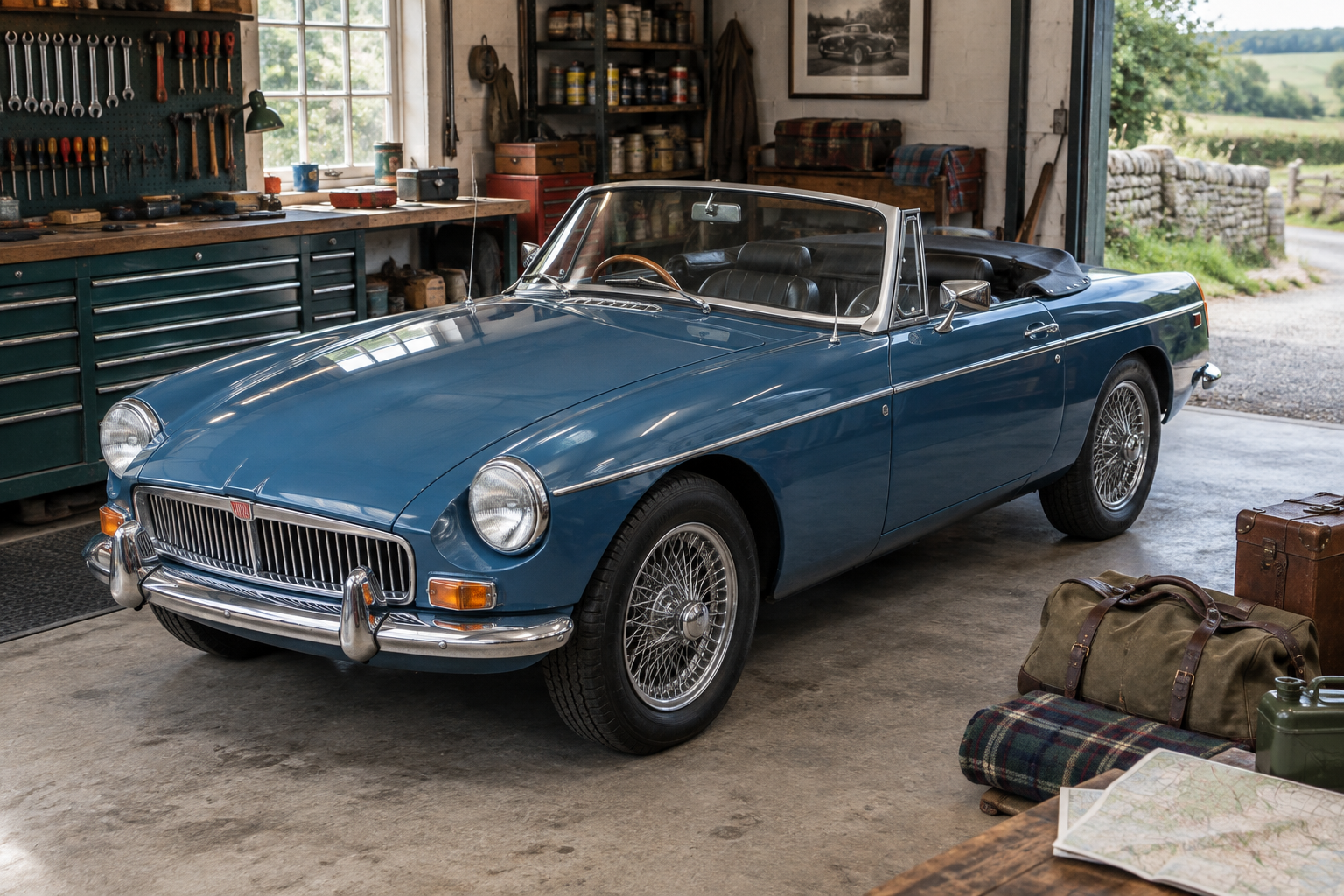
An MGB can be an excellent touring car. The driving position is engaging, the controls are straightforward and, in a Roadster or GT, the journey itself becomes part of the experience. However, a successful long-distance trip depends less on adding equipment and more on understanding the car’s condition, planning realistically and allowing time for the occasional interruption.
Touring preparation is not the same as preparing a car for competition or carrying out a full restoration. The aim is to make sure the MGB is reliable, comfortable and familiar before it leaves home. A methodical approach also helps reveal small faults while they are still convenient to address.
Start with the car’s recent history
Before making a list of improvements, consider what has already been done. Look at service invoices, inspection notes and your own maintenance records. If the car has recently received attention, identify which items were completed and when. If its history is incomplete, allow more time for general checks rather than assuming that a previous owner’s priorities match your own.
Pay particular attention to work that affects touring reliability. This includes engine servicing, fluid changes, belts, hoses, battery condition, charging performance, fuel-system maintenance and any work on the brakes, suspension or steering. A component that works well around town may still deserve closer consideration before several hours of continuous use.
If you are considering an MGB for touring, browsing current MGB stock can help you compare the types of cars available. A car intended for regular trips should be assessed for its condition, specification and suitability rather than simply its appearance.
Arrange a thorough pre-tour check
Give the car a proper inspection well before departure. This creates time to obtain parts, investigate faults and carry out a meaningful test drive. Leaving everything until the day before a trip often turns minor findings into unnecessary pressure.
Engine and fluids
Check the engine oil level and condition according to the instructions appropriate to your car. Look for signs of leakage around the engine, gearbox and rear axle, while remembering that a small mark on the floor does not identify the source by itself. Cleanliness around suspect areas can make fresh leaks easier to trace.
Inspect coolant hoses, fuel hoses and drive belts for deterioration, damage or insecure connections. Do not rely solely on appearance: a hose may look acceptable externally while still being old or unsuitable. If replacement is needed, use parts of the correct type and have the work completed before the trip so that the system can be checked afterwards.
Make sure the engine reaches and maintains its normal operating temperature during a road test. An unusual smell, misfire, hesitation, overheating indication or change in oil pressure deserves investigation rather than being dismissed as a characteristic of an older car.
Battery and charging
Starting problems are particularly inconvenient away from home. Check that the battery is secure, its terminals are clean and its cables are firmly attached. A battery that starts the car reliably in mild local use may still be near the end of its useful life, especially after repeated short journeys or a period of inactivity.
The charging system should be assessed as part of normal servicing. Look for warning-light behaviour that differs from normal and pay attention to changes in lamp brightness or electrical operation. If the battery or alternator has recently been disturbed, check the associated connections carefully.
Brakes, steering and suspension
Confirm that the brake pedal feels consistent and that the car stops in a straight line without pulling, juddering or unusual noise. Check for fluid loss and inspect visible pipework where practical. A brake fault should be treated as a priority, not as a touring inconvenience.
During a road test, note any looseness, knocking, wandering or reluctance to self-centre. These symptoms can have several causes, so avoid replacing parts by guesswork. A specialist inspection may identify whether the issue relates to adjustment, wear or another part of the system.
Tyres, lights and basic equipment
Check tyre pressures when the tyres are cold and inspect the tread, sidewalls and valve areas. Look for uneven wear, cracks, bulges or damage. The spare wheel, if fitted, should also be checked rather than treated as an afterthought. Make sure the wheel-changing tools are present and usable.
Test headlamps, sidelamps, indicators, brake lamps, reversing lamps and the horn. Ask someone to observe the exterior lights where possible, as a lamp may appear to work from the driver’s seat without being clearly visible from outside. Carry spare bulbs and fuses only where they match the car’s actual requirements.
Use a proper test journey
A short drive around the block is not enough to validate a touring car. Plan a test journey that includes slower roads, faster sections, junctions, gradients and a period of continuous running. The purpose is not to simulate every possible route, but to give the car and driver a chance to settle into normal touring conditions.
After the drive, inspect the car again. Look for fresh fluid marks, loose trim, changes in belt tension, unusual smells or anything that has moved in the luggage area. Also consider how you felt after the journey. Driving comfort is part of reliability: a seating position, mirror arrangement or hood operation that is tolerable for half an hour may become tiring over a full day.
Pack for the car you have
Storage space in an MGB should be used thoughtfully. Heavy items should be secured and placed so that they do not interfere with pedals, steering, visibility or access to the battery and spare wheel. Soft luggage is often easier to arrange than rigid cases, but every item should remain contained during braking and cornering.
Prepare a small, organised roadside kit rather than carrying an unstructured collection of parts. Depending on the car and your own ability, this might include basic hand tools, gloves, a torch, fuses, bulbs, electrical tape, cable ties and a means of checking or inflating a tyre. A phone charger, paper details for important contacts and a basic first-aid kit can also be sensible additions.
Do not fit equipment simply because it is fashionable or because it worked on another MGB. Additional electrical accessories, luggage systems and modifications should be installed securely and checked for compatibility with the individual car. Poorly fitted additions can create new faults and make future diagnosis more difficult.
Make the cabin work for touring
Comfort does not require turning an MGB into a modern car. Small adjustments can make a substantial difference. Set the seat, mirrors and steering position before departure, and make sure the controls can be reached without stretching or taking attention from the road.
Check that the hood can be raised and lowered without forcing it, and understand how it should be folded and secured. If travelling in a Roadster, practise the operation at home rather than discovering a difficult sequence during a sudden change in weather. In a GT, check the tailgate seal and ensure that luggage cannot obstruct the driver’s view.
Ventilation is also worth considering. Clean the relevant vents and make sure the controls operate as intended. Keep commonly needed items accessible, while avoiding loose objects on the dashboard or parcel shelf.
Plan routes with flexibility
Classic-car touring is usually more enjoyable when the route allows for breaks and changes of plan. Consider fuel stops, places to rest and the type of roads that suit both the car and the occupants. A route that looks short on a map may be tiring if it involves constant traffic, steep gradients or long stretches without a convenient stopping place.
Navigation should have a backup. Electronic devices are useful, but battery life, signal coverage and mounting arrangements should not be taken for granted. Keep the route information accessible without creating a distraction, and agree in advance how the driver and passenger will deal with missed turns.
Check practical restrictions that apply to your chosen route before leaving, including parking arrangements and any local access requirements. These can change independently of the car and should be verified close to the journey.
Know how to respond to a roadside problem
Preparation cannot eliminate every fault. It can, however, make a problem easier to manage. If the car develops an issue, stop in a safe location and assess the symptoms before attempting a repair. Do not work beneath an inadequately supported vehicle, and never investigate a hot or pressurised system carelessly.
Write down useful information before travelling, including breakdown assistance details, insurance contacts and the location of any security devices or isolators fitted to the car. If a fault cannot be resolved safely, professional recovery is preferable to extending the damage or putting people at risk.
Afterwards, record what happened while the details are fresh. An intermittent fault may be easier to diagnose when symptoms, weather, engine temperature and driving conditions are documented clearly.
Improve gradually and retain the car’s character
Touring preparation can reveal worthwhile improvements, but changes should be approached in stages. First make the existing systems healthy and correctly adjusted. Only then decide whether a modification addresses a genuine need.
For an MGB being rebuilt or substantially updated, it can be useful to understand the intended specification before work begins. The MGB rebuild specification provides a relevant point of reference, while questions about a particular car or proposed work can be directed through the contact page.
Keep records of modifications, servicing and replacement parts. This helps with future maintenance and ensures that the next owner can understand what has been changed. It also prevents the common problem of repeatedly replacing parts because previous work was not recorded.
Enjoy the preparation as well as the journey
The best touring MGB is not necessarily the most highly modified or cosmetically perfect car. It is one whose condition is understood, whose faults are dealt with sensibly and whose driver has planned enough to enjoy the road without constant concern.
Carry out checks early, test the car properly, pack securely and leave room for unplanned stops. With those habits in place, an MGB can make even an ordinary trip feel purposeful, involving the driver in every mile while retaining the character that makes classic-car touring so appealing.